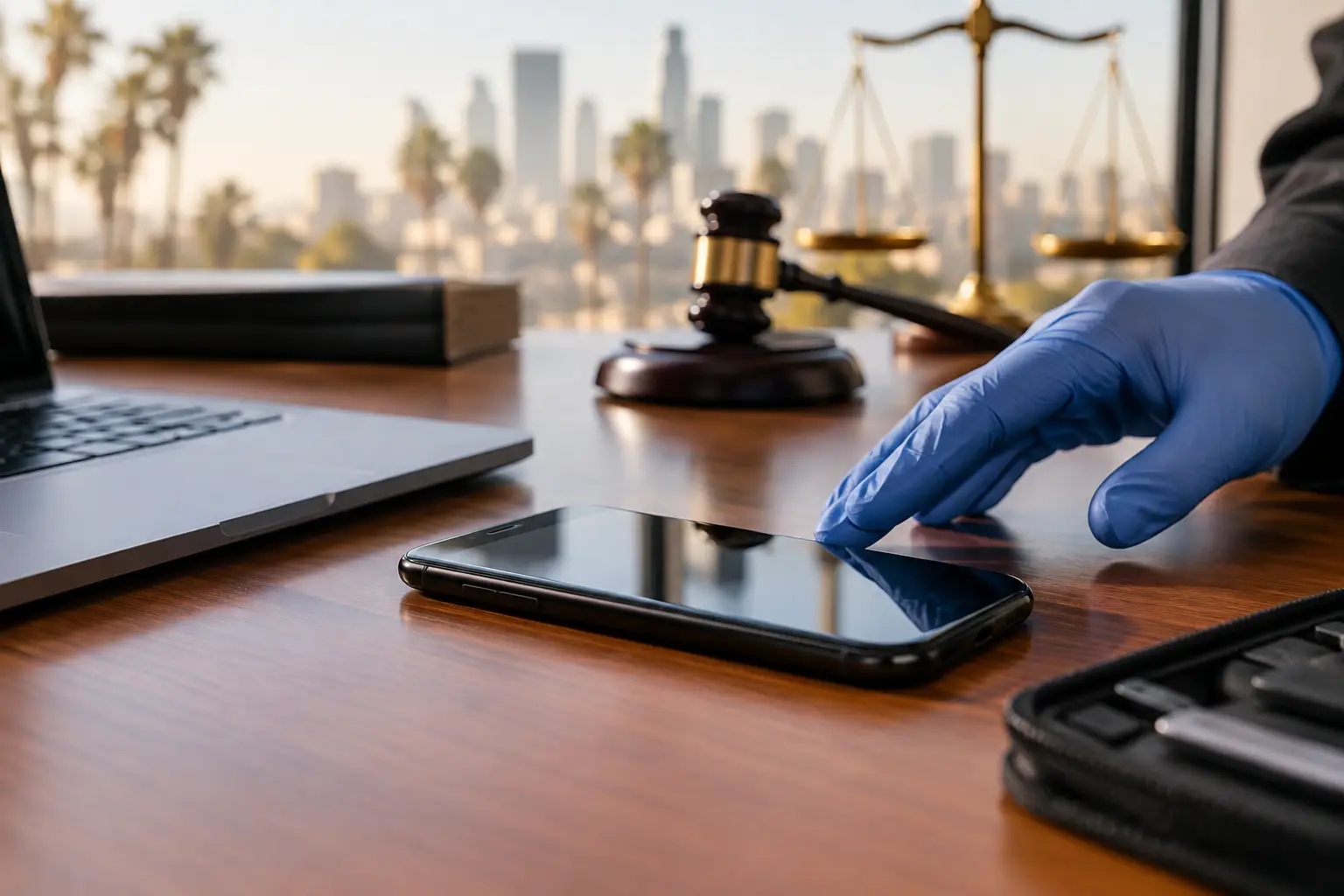
A phone can contain the prosecution’s most persuasive evidence – or the strongest basis for a suppression motion. Phone search challenges often arise after an arrest in Los Angeles County because investigators treat a device as a record of private conversations, movements, photographs, financial activity, and relationships. The fact that police seized a phone does not automatically give them the right to examine what is inside it.
The first hours after a seizure matter. Do not consent to a search, do not provide a passcode, and do not try to delete information. Exercise the right to remain silent and ask to speak with counsel. Deleting material can create a separate problem and may be used by the prosecution to argue consciousness of guilt. A defense lawyer can evaluate how the phone was taken, what authority officers relied on, what data they obtained, and whether that evidence can be kept out of court.
Why phone search challenges matter
Cellphones are not treated like ordinary containers under the Fourth Amendment. In Riley v. California, the United States Supreme Court held that police generally need a warrant before searching the digital contents of a cellphone seized during an arrest. Officers may take the phone to prevent its loss or destruction, but seizure and search are different legal events.
That distinction can affect a wide range of Southern California cases. In a domestic violence case, prosecutors may rely on messages, call histories, or images. In a drug, weapons, robbery, or gang allegation, they may point to photographs, social-media communications, mapping data, contacts, or notes. A phone may also be central to an internet-crimes investigation or a federal case in the Central District of California.
Digital evidence can look powerful in a police report while remaining legally vulnerable. A screenshot does not establish who sent a message. A location entry may show where a device was, not who possessed it. A contact name, nickname, or social-media account may be incomplete, misleading, or controlled by more than one person. The defense must challenge both the legality of the search and the prosecution’s interpretation of the information found.
When police may search a phone without a warrant
There are exceptions to the warrant requirement, but they are narrower than many people assume. The prosecution must be able to identify a valid legal basis for the search. In court, the details of timing, officer conduct, and the exact scope of the search can be decisive.
Consent and its limits
Police may argue that the owner consented to a phone search. Consent must be voluntary, and its scope matters. Agreeing that an officer may look at a recent text message is not necessarily permission to conduct a full forensic extraction of the device, examine years of photographs, or access cloud-based accounts.
An officer’s request can be especially problematic when a person is handcuffed, surrounded by police, frightened, or unclear about the consequences of saying yes. A signed consent form is relevant, but it does not end the analysis. The court may need to consider what officers said, whether the person understood the request, and whether consent was later withdrawn.
Exigent circumstances
Officers may sometimes search without a warrant when they reasonably believe an emergency requires immediate action, such as an imminent threat to life or a serious risk that evidence will be destroyed. This is not a general shortcut for convenience. The government must connect the emergency to the particular search it conducted.
For example, concern that someone could remotely wipe a device may justify securing it while officers seek a warrant. It does not necessarily justify opening the phone and scrolling through its contents first. Courts examine whether less intrusive measures were available.
Probation, parole, and search conditions
A probation or parole search condition can change the analysis, but it does not give law enforcement unlimited authority to search every digital account connected to a person. The wording of the condition, the person’s status, the officer’s knowledge, and the nature of the search all matter.
This is an area where assumptions can be costly. Someone on supervision should not assume that officers can lawfully search any device under any circumstance. At the same time, a defense must be built on the actual terms of supervision rather than a broad claim that a warrant was always required.
A warrant is not the end of the issue
When investigators obtain a warrant, the next question is whether it was supported by probable cause and described the permitted search with sufficient particularity. Phones hold enormous volumes of information. A warrant cannot simply become a license to look through everything because officers suspect some evidence might be present somewhere.
A careful review asks what crime the warrant identified, what facts linked the phone to that crime, what categories of data officers could search, and what time period was authorized. A warrant seeking evidence of a recent alleged assault may not justify an unrestricted review of years of unrelated personal records.
The affidavit supporting the warrant also deserves close scrutiny. Was the information stale? Did officers make material omissions? Did they rely on an unverified accusation or a vague claim that criminals commonly use phones? These issues may support a motion to suppress evidence under Penal Code section 1538.5 in the appropriate California case.
The forensic extraction must be examined
Many phone cases turn on a forensic report, not just a warrant. Investigators may use specialized software to extract texts, images, deleted artifacts, location information, application data, and metadata. The report can be extensive, technical, and far more damaging in appearance than in substance.
A courtroom-focused defense examines what the tool actually recovered and what it did not. Was the phone unlocked? Was the extraction complete or partial? Did the software identify a file as deleted, transferred, cached, or manually created? Were messages recovered from the device itself, or from an account associated with it? Can the report reliably establish dates, authorship, or possession?
Chain of custody matters as well. The prosecution must be able to show what device was seized, who handled it, how it was preserved, and whether the data presented in court accurately reflects the original evidence. A gap in documentation may not automatically exclude evidence, but it can create a serious credibility issue at a preliminary hearing or trial.
Phone data does not automatically prove identity or intent
The prosecution still has the burden to prove the charged offense beyond a reasonable doubt. Digital material often requires interpretation, and interpretation is where mistakes occur.
A phone may be shared by family members, roommates, coworkers, or partners. A message may be sarcastic, incomplete, forwarded, or taken from a conversation missing key context. Location data may be imprecise. A photograph may lack a reliable date or source. Even a person’s presence near a location does not necessarily prove participation in a crime.
In Los Angeles criminal cases, investigators may also use a phone to build associations between people. A contact list or group message is not proof that every person knew about, joined, or intended an alleged offense. The defense should identify the assumptions embedded in the investigation rather than accepting the government’s narrative as fact.
What to do after police seize your phone
Do not attempt to retrieve the device through informal contact with detectives. Do not call witnesses to coordinate accounts, post about the matter, or access linked accounts to alter information. Preserve any documents left by police, including a property receipt, warrant, inventory, or notice of seizure.
Write down what happened while you remember it: who took the phone, whether you were arrested, what officers asked, whether they requested a passcode, whether you said anything about ownership, and whether you were shown paperwork. That information may become critical when counsel evaluates a suppression motion or challenges the reliability of a forensic extraction.
Early legal work can also shape the broader case. It may affect charging discussions, bail arguments, the evidence presented at a preliminary hearing, trial preparation, and potential post-conviction issues. The right strategy depends on whether police have the device, obtained a warrant, extracted data, or are trying to obtain records from a service provider.
If law enforcement has seized or searched a phone in North Hollywood, Los Angeles, or anywhere in Southern California, contact Wegman & Levin APC at (818) 495-8330 for a confidential consultation. Relentless Defense. Proven Results. begins with a careful examination of what police did, what the warrant allowed, and what the prosecution can actually prove.