A surveillance clip may look decisive when it is played once in a police interview room or at a preliminary hearing. But a few seconds of footage rarely tell the whole story. A forensic video evidence review asks harder questions: Where did the file come from? Is it complete? Does the timestamp mean what the prosecution says it means? Can the recording actually identify the person alleged to be involved?
For someone facing charges in Los Angeles County, video can shape bail arguments, charging decisions, plea discussions, and trial strategy. It can also be misleading. Cameras record from a fixed angle, often in poor lighting, with distorted perspective and no context before or after the event. The defense should not accept the prosecution’s description of a video without examining the underlying evidence.
What a Forensic Video Evidence Review Actually Examines
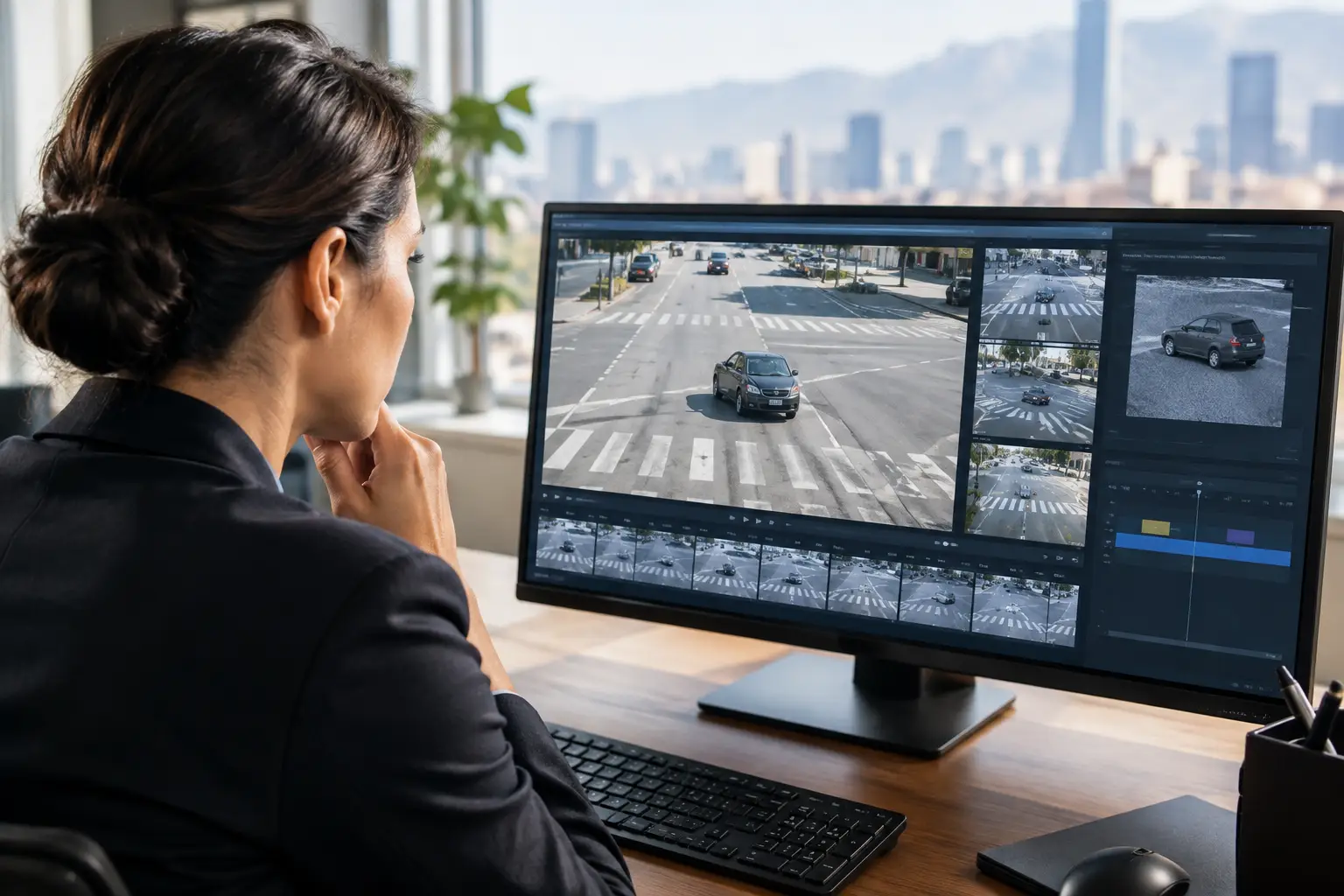
A meaningful review is more than watching a clip repeatedly. Defense counsel must determine whether law enforcement obtained the original recording, a copied file, a phone video of a monitor, or an edited excerpt. Those are not interchangeable forms of evidence.
The original or native file may contain metadata, including the device information, creation date, file structure, and other technical details. A copied or converted version may lose some of that information. It may also change image quality, frame rate, or audio synchronization. When identification, sequence of events, or precise timing matters, those differences can matter a great deal.
A review may focus on several practical issues:
- whether video exists from before and after the excerpt the prosecution intends to use;
- whether other cameras at the location captured a different angle;
- whether the device clock was accurate or had not been adjusted for time changes;
- whether compression, low light, motion blur, glare, or digital zoom affects what can reliably be seen; and
- whether an exported clip has gaps, edits, or an unexplained change in format.
This inquiry is especially important in assault, robbery, theft, DUI, domestic violence, and homicide investigations, where the prosecution may rely on video to establish identity, intent, impairment, possession, or the sequence of an alleged encounter.
The Difference Between Seeing Someone and Identifying Them
A person can appear in a recording without the recording proving who that person is. That distinction is often lost when police or witnesses view video after they have already formed a suspicion.
Identification can be weakened by distance, shadows, masks, hats, camera placement, and image resolution. A camera mounted high above a parking lot may capture clothing color and movement but not reliable facial features. A doorbell camera may distort objects or people near the edge of its lens. Video shown at normal speed can make a movement appear deliberate when frame-by-frame review, or footage from another angle, tells a different story.
The defense also examines whether investigators used suggestive methods when presenting video to a witness. If an officer says, directly or indirectly, that a particular person is the suspect before asking for an identification, the resulting opinion may be less reliable. An accusation should not be built on a witness being shown a grainy clip and asked to confirm what investigators have already decided.
In court, the prosecution must establish a proper foundation for video evidence. Under California Evidence Code section 1401, the proponent of evidence must produce evidence sufficient to support a finding that the item is what it claims to be. That does not mean every video dispute leads to exclusion. It does mean the source, handling, accuracy, and relevance of the footage can be challenged where the facts support it.
Missing Footage Can Be as Important as the Clip Shown
One of the first questions should be what happened immediately before and after the recording the government selected. A 20-second segment may show a confrontation. The preceding minutes may show threats, an attempt to leave, self-defense, or another person initiating physical contact. Later footage may contradict a claim that someone fled, concealed evidence, or acted with consciousness of guilt.
Many businesses use systems that overwrite recordings after a limited period. Apartment buildings, retail stores, parking facilities, and private homes may not retain video for long. That creates urgency. Once a person learns of an investigation or arrest, counsel may need to act promptly to seek preservation of potentially favorable footage.
The prosecution has discovery obligations under California Penal Code section 1054.1, including disclosure of relevant recorded statements and other specified material and information in its possession or known to investigating agencies. But private third-party footage is not necessarily already in the government’s hands. A defense investigation may need to identify the camera owner, determine whether footage was preserved, and use appropriate legal process when necessary.
A missing recording does not automatically end a case. Nor does it automatically prove misconduct. The reason the footage is unavailable matters. So does whether law enforcement knew of the evidence, had access to it, or failed to preserve material that could have been significant to the defense.
Timing Errors Can Change the Theory of the Case
Timestamps are frequently treated as precise, but they are only as accurate as the device settings. A surveillance system might be several minutes fast or slow. A cellphone video may reflect a different time source. Daylight saving adjustments, power failures, manual changes, and incorrect installation settings can all affect the displayed time.
That issue can be central to an alibi. It can also affect a DUI case when the prosecution is attempting to establish the interval between driving, detention, and chemical testing. In a violent-crime allegation, timing can determine whether a person had the opportunity to be present or whether the prosecution’s sequence is physically possible.
The defense should compare the recording with independent reference points when available. A 911 call log, dispatch record, receipt, access-control record, text message, or another camera may help establish the actual timeline. The point is not to assume every timestamp is wrong. It is to require proof before treating it as fact.
Video Enhancement Is Not the Same as Clarification
Investigators may brighten footage, enlarge an image, stabilize a recording, slow it down, or sharpen contrast. Some enhancement techniques can make material easier to view. They can also create an impression of detail that was never reliably captured.
Enlarging a small, compressed image does not necessarily reveal new information. It may simply make pixels larger. Excessive sharpening can create edges or features that viewers interpret as facial details, objects, or movements. Audio processing presents similar concerns when background noise, clipping, or compression affects what is allegedly said.
When the prosecution relies on enhanced media, the defense should seek to review both the original material and the process used to create the enhanced version. The issue is not whether an expert used technology. The issue is whether the technique is reliable, reproducible, and fairly presented to the court or jury.
How Video Issues Are Raised in a Criminal Case
The right response depends on the charge, the stage of the case, and what the video actually shows. At a preliminary hearing, video may be tested through cross-examination of the investigating officer, witness, or custodian. At trial, the defense may challenge authentication, relevance, reliability, unfair prejudice, or the conclusions an expert draws from the recording.
In some cases, the strongest use of video is affirmative: it supports an alibi, shows self-defense, contradicts an officer’s account, or establishes that a witness could not have seen what they claim. In other cases, the key is exposing uncertainty. A prosecutor may characterize a clip as proof of identity or intent, while a careful examination shows only an ambiguous image.
A defense attorney should also assess how the recording was obtained. If police accessed video through a search, seizure, or digital extraction that violated constitutional protections, a suppression issue may exist. That analysis is fact-specific. It should be addressed early, before critical deadlines pass or the case becomes locked into an inaccurate narrative.
Do Not Explain the Video to Police
If detectives want to question you about a recording, they may say they simply want your side. They may also suggest that the video makes the case obvious. Do not try to explain away a clip, identify other people, or fill in perceived gaps without legal advice. Statements made under pressure can become a separate part of the prosecution’s evidence, even if the video itself is unclear.
Exercise your right to remain silent and contact counsel before speaking with law enforcement. Preserve any messages, photos, location data, receipts, or other records that may help establish context, but do not alter, delete, or post about the evidence online.
Video evidence deserves a careful, technically informed, courtroom-focused response. At Wegman & Levin APC, Relentless Defense. Proven Results. means examining the evidence the prosecution relies on, as well as the evidence it failed to pursue.
If video is part of an arrest, investigation, or pending case in North Hollywood, Los Angeles County, or elsewhere in Southern California, contact Wegman & Levin APC at (818) 495-8330 for a confidential consultation before speaking with investigators or accepting the prosecution’s version of what the recording shows.