
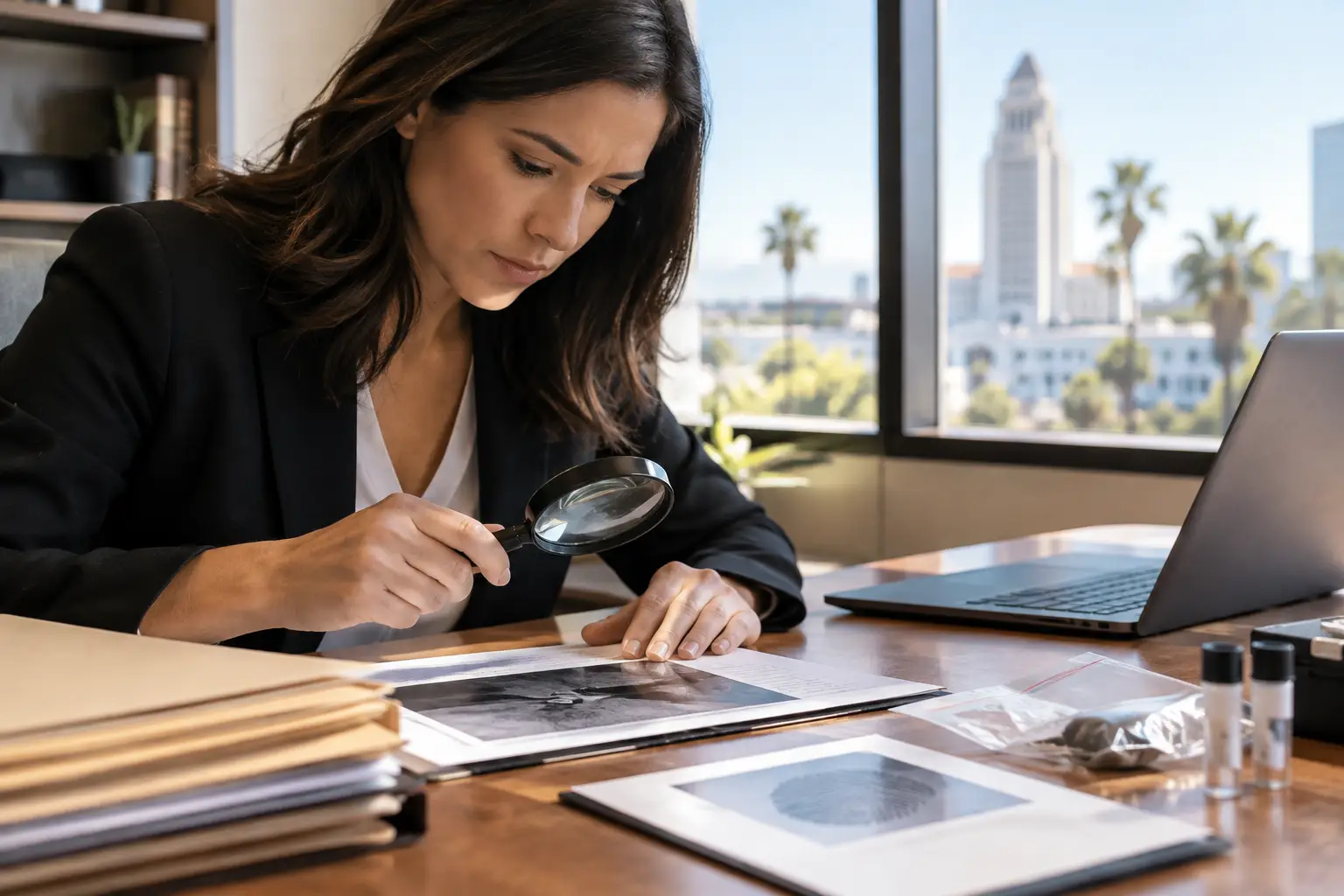
A lab report can look final long before it has been meaningfully tested. After an arrest in Los Angeles County, prosecutors may point to DNA, toxicology, firearm, phone, or drug-analysis results as though a printed conclusion settles the case. A forensic report review asks a different question: what does the underlying work actually establish, and what does it leave uncertain?
That distinction can affect charging decisions, bail arguments, preliminary hearings, plea negotiations, trial strategy, and sentencing. The report itself is only the starting point. A defense attorney must examine the evidence that produced it, the methods used, the qualifications and conclusions of the analyst, and whether the prosecution can present admissible testimony in court.
What a Forensic Report Review Actually Examines
Forensic testing is not one thing. A DNA report may involve collection swabs, laboratory extraction, quantification, amplification, interpretation of a profile, and statistical reporting. A DUI blood report may turn on the collection procedure, preservatives in the vial, storage conditions, instrument calibration, and the analyst’s calculations. Digital evidence can depend on how a phone was seized, imaged, searched, and attributed to a particular person.
The first task is to identify exactly what the report claims. Some reports identify a substance. Others state that a sample is consistent with a person, that a firearm may have fired a cartridge case, or that data was recovered from a device. Those are materially different claims. The language may be stronger or more limited than the prosecution’s presentation of it.
A careful review also separates a laboratory conclusion from the larger inference the government wants the judge or jury to draw. Finding a person’s DNA on an item, for example, does not automatically establish when it was deposited, whether that person handled the item during the alleged offense, or whether transfer through another object is possible. A positive drug test may establish the presence of a substance in a sample, but not necessarily impairment at a particular time or knowledge of possession.
The Records Behind the Conclusion Matter
An attorney should not accept a summary report as the complete forensic record. Depending on the evidence involved, the defense may seek bench notes, analytical data, laboratory worksheets, photographs, calibration and maintenance records, chain-of-custody documentation, analyst training records, quality-control material, and communications about the testing.
These records can reveal whether the conclusion is well-supported or whether important context is missing. For example, an analyst may have rerun a test, encountered an inconclusive result, used a limited sample, or interpreted a mixed DNA profile. None of those facts automatically invalidates the result. They may, however, be essential to a fair assessment of its weight.
Chain of custody deserves particular attention. The prosecution must be able to show a reliable path from the scene or seizure to the evidence room, laboratory, and courtroom. A minor clerical error does not always make evidence unusable. But unexplained gaps, inconsistent item descriptions, broken seals, or uncertainty over which item was tested can create a substantial issue. The significance depends on the evidence and the record, not on a checklist.
In narcotics cases, the defense may examine whether the item booked as evidence is the same item tested by the lab and whether the tested amount supports the allegation. In weapons cases, the condition of the firearm, the ammunition, and the testing protocol may matter. In alleged sex-offense or violent-crime cases, sample collection, contamination safeguards, and the interpretation of mixed or partial biological evidence can be central.
Limits Are Not Loopholes
Jurors often give scientific evidence great weight. That is why the limits of forensic testing must be explained precisely, rather than exaggerated. A valid defense does not require proving that a laboratory acted improperly. It may be enough to show that the evidence is less definitive than the prosecution claims, that competing interpretations are reasonable, or that a required link in the government’s proof remains missing.
Consider a fingerprint comparison. The issue may not be whether a print was recovered, but whether it was of sufficient quality for a reliable comparison and whether its presence establishes timing or conduct. With cell phone evidence, location data may place a device within an area while saying far less about the person holding it, the precise location, or the alleged conduct.
In a DUI prosecution, a reported blood-alcohol concentration does not answer every question. The timing of driving, the timing of the blood draw, medical conditions, the collection process, and the scientific basis for any backward calculation can all matter. In a drug case, laboratory identification of a controlled substance may leave open questions about possession, knowledge, ownership, or an unlawful search.
The defense must focus on the issue that matters to the charge. A technically sound lab result can still fail to prove identity, intent, possession, impairment, or another required element beyond a reasonable doubt.
How the Review Shapes Courtroom Strategy
A forensic report review should begin early. Waiting until the eve of trial can make it harder to obtain records, locate an independent expert, investigate the collection process, or litigate the proper scope of expert testimony. Early analysis also helps counsel decide whether a case calls for further discovery, a suppression motion, a challenge to expert evidence, or focused cross-examination at a preliminary hearing or trial.
Not every case requires hiring an outside expert. That decision depends on the charge, the importance of the evidence, the available records, the complexity of the method, and the defense theory. In some cases, a thorough attorney review exposes the relevant problems and supports effective questioning of the prosecution’s witness. In others, an independent forensic specialist is necessary to interpret raw data or explain why a conclusion is unreliable or overstated.
At a preliminary hearing, the immediate objective may be to preserve testimony, identify weaknesses, and test the prosecution’s theory before the case is held to answer. At trial, the defense may need to show a jury the difference between a scientific result and a prosecutor’s interpretation of that result. Those are related but different tasks.
There are also situations where the most important forensic issue begins before the laboratory. If police obtained a phone, blood sample, computer, or other item through an unlawful search or seizure, the defense may challenge whether the evidence should be used at all. A persuasive forensic conclusion does not cure a constitutional violation in how the item was obtained.
What to Do After You Receive a Report or Learn Testing Is Pending
Do not try to explain the report to detectives, a prosecutor, an alleged victim, or potential witnesses. Casual statements can be treated as admissions or used to fill gaps in the government’s proof. Exercise the right to remain silent and speak with counsel before answering questions about the evidence.
Preserve materials that may provide lawful context, including messages, photographs, receipts, location information, medical records, or names of witnesses. Do not alter, delete, or attempt to access another person’s accounts or devices. What helps a defense is often not a dramatic alternative story, but reliable evidence showing that a forensic result does not prove the accusation being made.
If the case involves a family member, avoid posting about it online or trying to investigate witnesses yourself. Get the charging papers, bail paperwork, court date, and any report you have received to counsel promptly. A lawyer can determine what additional discovery should be requested and whether immediate action is needed before evidence or testimony becomes harder to evaluate.
For people facing professional licensing, immigration, employment, or custody consequences, the review must also account for the pressure to resolve a case quickly. A plea may have consequences far beyond the courtroom. Understanding the actual strength and limits of forensic evidence is necessary before making a decision that cannot easily be undone.
A Report Is Evidence, Not a Verdict
The prosecution has the burden to prove a criminal charge. A scientific label on a report does not shift that burden, and it does not eliminate the need for careful defense investigation. The strongest approach is disciplined: obtain the underlying material, identify what the method can and cannot show, test the chain of custody, and connect every issue to the elements the prosecution must prove.
If a forensic report is driving an investigation or criminal case in North Hollywood, Los Angeles County, or anywhere in Southern California, contact Wegman & Levin APC at (818) 495-8330 for a confidential consultation. Relentless Defense. Proven Results. Early review can preserve options before a report becomes the prosecution’s unchallenged narrative.


