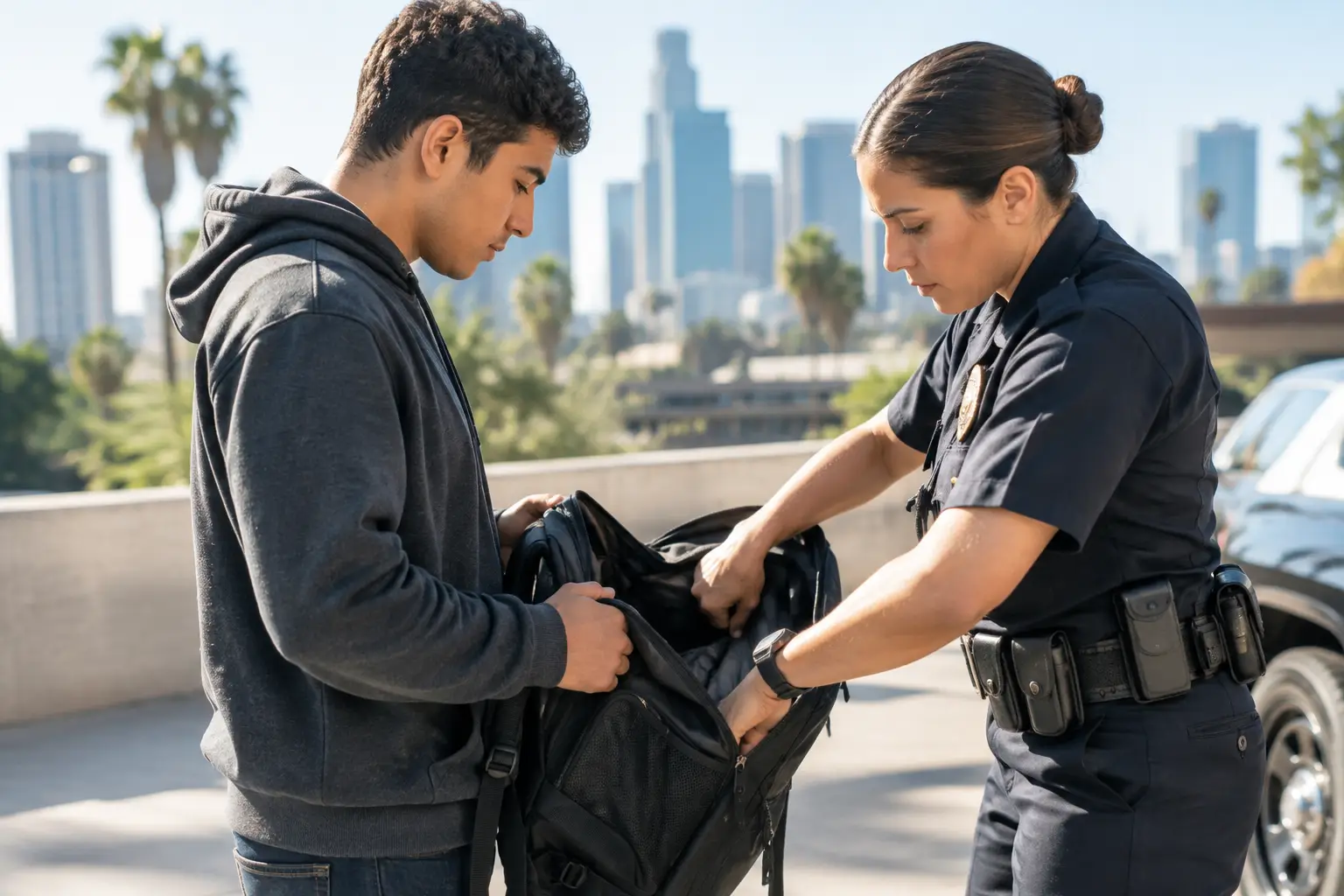
A backpack often becomes the center of a criminal case in seconds. An officer asks, “Mind if I take a look?” A bag is set on the hood of a patrol car during a traffic stop. Or police unzip it after an arrest and find a firearm, narcotics, cash, or personal information they claim connects someone to a crime.
Can police search backpacks in California? Sometimes. But a backpack is generally a private container protected by the Fourth Amendment. Police do not have unlimited authority to open it simply because they are questioning you, stopping your car, or suspecting that something may be inside.
The legal justification for the search matters. So does the precise sequence of events: what officers knew before opening the bag, whether you were free to leave, whether you gave consent, and whether the backpack was on your person, in a car, at school, or left behind. Those details can determine whether the evidence is admissible in a Los Angeles County courtroom.
When Police Can Search a Backpack
Police ordinarily need a warrant to search private property. A warrant must be supported by probable cause and describe the place and property to be searched with sufficient particularity. In practice, however, many backpack searches occur under exceptions to the warrant requirement.
You consented to the search
Consent is one of the most common grounds officers cite. If you voluntarily agree to let police search your backpack, they may generally search within the scope of that permission. Saying, “You can check the front pocket,” is different from agreeing to a full search of every compartment.
Officers do not have to tell you that you may refuse. They also may ask in a way that makes the encounter feel less optional than it is. A calm, direct response is often best: “I do not consent to a search.” Do not physically resist, pull away, or interfere with an officer. A refusal to consent does not give police automatic permission to search, although officers may still rely on another legal basis if one exists.
The search followed a lawful arrest
After a lawful custodial arrest, police may generally search the arrested person’s clothing and items closely associated with that person, including a backpack being worn or carried at the time of arrest. This is known as a search incident to arrest. Officers do not need a separate warrant for that limited search.
The key question is whether the arrest itself was lawful. If police lacked probable cause to arrest, the prosecution may have a problem using the backpack evidence. Timing can also matter. A bag that was immediately associated with the person at arrest is different from a backpack secured well away from the arrestee and searched later without a warrant.
Police had probable cause during a vehicle stop
A traffic stop does not automatically authorize officers to search the driver’s or passenger’s backpack. An officer may ask for consent, but a request is not a legal command.
If police develop probable cause that a vehicle contains evidence of a crime or contraband, the automobile exception can permit a warrantless search of areas and containers where the item could reasonably be found. That may include a backpack in the passenger compartment, even if the bag belongs to a passenger. The scope of the search must still match what officers had probable cause to look for. Probable cause to search for a large stolen television, for example, would not justify opening a small zippered pouch.
Police cannot transform a routine traffic infraction into a prolonged drug investigation based on a hunch. The duration of the stop, the officer’s observations, dispatch information, canine deployment, statements by occupants, and any claimed odor of contraband can all become important issues in a suppression motion.
Officers reasonably believed they faced a weapons threat
During a lawful detention, police may conduct a limited protective frisk if they can point to specific facts suggesting that a person is armed and dangerous. A protective search of a backpack may be justified where the bag is within the person’s immediate reach and officers reasonably believe it may contain a weapon.
This is not a general evidence search. A weapons frisk is limited by its purpose. If an officer opens every pocket and searches for drugs, documents, or unrelated evidence without probable cause or consent, the search may exceed constitutional limits.
A probation or parole search condition applied
A person on parole is generally subject to search conditions that can allow warrantless searches by law enforcement. Some probationers also have search terms, but the language of the probation order matters. Officers may need to know of the condition before conducting the search, and the search cannot be arbitrary, capricious, or conducted solely to harass.
These cases require careful review. A probation search term does not automatically authorize police to search every bag near a probationer, especially when the backpack clearly belongs to someone else. Ownership, possession, access, and what officers knew at the time are often disputed.
When Police Cannot Search Backpacks Without More
Police may not search a backpack merely because its owner looks nervous, is standing in a high-crime area, or declines to answer questions. Nervousness and vague suspicion may justify further observation in some circumstances, but they do not alone establish probable cause to open a closed bag.
The same is true when a backpack is temporarily seized during an investigation. Police may sometimes secure property while seeking a warrant if they have a lawful basis to do so, but securing a bag is not the same as searching its contents. The prosecution must identify a valid exception or a warrant before relying on what officers found inside.
A claimed “plain view” discovery also has limits. Police must be lawfully present, and the incriminating nature of the item must be immediately apparent. Seeing a closed backpack does not place its contents in plain view.
Backpack Searches at Schools and Juvenile Cases
Public school officials can search a student’s backpack under a lower standard than police typically need. Under the Supreme Court’s decision in New Jersey v. T.L.O., school officials generally need reasonable grounds to suspect the search will uncover evidence that the student violated school rules or the law. The search must be reasonably related in scope to that suspicion.
That does not mean school backpack searches are automatically valid. A search based on an anonymous accusation, a broad sweep of multiple students’ property, or an excessively intrusive inspection may raise serious issues. Cases become more complicated when campus police or outside law enforcement direct or join the search.
For families in the San Fernando Valley and Los Angeles County, a school incident can lead to both juvenile court consequences and school discipline. Do not assume that because an administrator found something in a bag, the evidence cannot be challenged later.
How a Defense Lawyer Challenges the Search
The question is not simply whether police found contraband. The question is whether they had the legal right to find it. Defense counsel should obtain body-camera footage, radio communications, dispatch records, reports, surveillance video, consent forms, and the complete timeline of the detention and search.
In California, a motion to suppress evidence under Penal Code section 1538.5 may challenge an unlawful search or seizure. Depending on the charge and procedural posture, the issue can be litigated at a preliminary hearing, in a dedicated suppression hearing, or before trial. A successful challenge can exclude physical evidence and, in some cases, statements or additional evidence obtained because of the unlawful search.
The prosecution may argue that consent was voluntary, that the bag was searched incident to arrest, or that officers had probable cause based on what they saw or smelled. The defense must test each claim against the video, reports, witness accounts, and constitutional limits. Small inconsistencies matter when the state’s case depends on what officers say happened in a brief street encounter.
What to Do After Police Search Your Backpack
Do not try to explain away an item in the bag on the scene. Ownership, knowledge, access, and intent are often central issues in drug, weapons, theft, and identity-related cases. Casual statements can be treated as admissions, even when they were made under pressure or confusion.
Exercise your right to remain silent and ask for counsel. Write down the location, time, officers’ names or badge numbers, witnesses, and everything you remember about the request to search and your response. Preserve messages, receipts, or other records that may establish who owned the backpack or who had access to it. Do not delete anything or contact potential witnesses to coordinate stories.
A backpack search can look straightforward in a police report while concealing a serious constitutional problem. Wegman & Levin APC provides direct, courtroom-focused defense for people facing charges after police searches in North Hollywood, Los Angeles County, and throughout Southern California. Relentless Defense. Proven Results. Call (818) 495-8330 for a confidential consultation before speaking with investigators or making decisions about your case.