
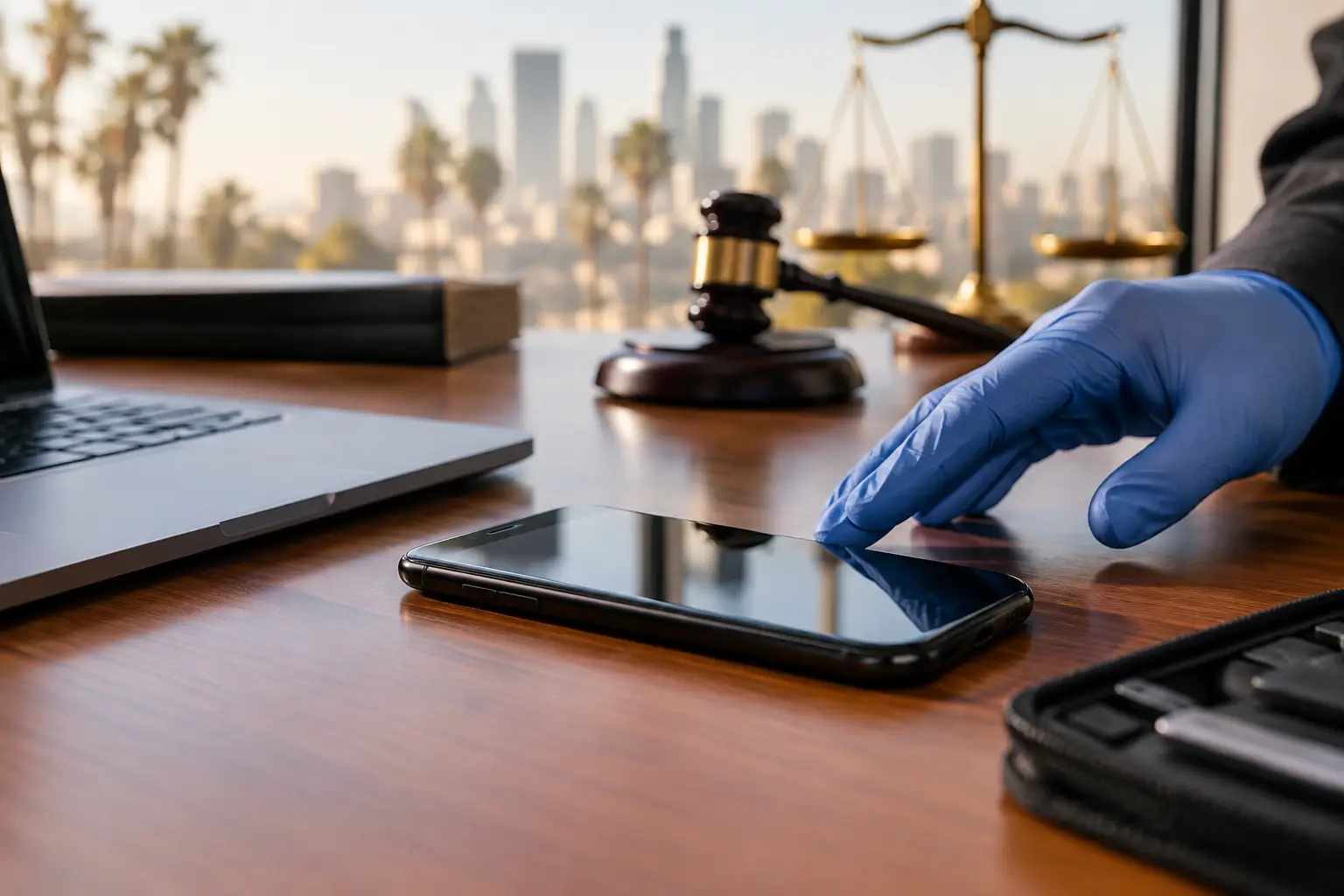
A cellphone extraction review can become the center of a criminal case long before anyone testifies. Police may treat a phone as a record of where you went, whom you spoke with, what you searched, and what you intended. But a forensic report is not a neutral account of the truth. It is a collection of data produced by a tool, interpreted by an investigator, and offered by prosecutors for a particular purpose.
If law enforcement seized your phone in Los Angeles County, do not try to explain its contents, provide a passcode, delete material, or contact people connected to the investigation. Exercise your right to remain silent and speak with counsel promptly. The legality of the search and the meaning of the data often require immediate, detailed review.
What a cellphone extraction actually produces
A cellphone extraction is the forensic collection of information from a phone, SIM card, cloud-connected account, or related storage source. Investigators commonly use specialized software to copy available data and generate a report. Depending on the device, passcode status, operating system, and extraction method, the report may include messages, call logs, contacts, photographs, videos, location artifacts, browser history, application data, social-media material, and fragments of deleted information.
The word “extraction” can create a false impression that police obtained everything on the device. They may not have. A locked phone may yield very little. An unlocked device may produce much more. Some records may have been overwritten, encrypted, stored only in the cloud, or unavailable to the particular forensic tool used. The report may also contain duplicate records, incomplete conversations, or technical entries that need context before they mean anything.
That distinction matters in cases involving alleged drug sales, domestic violence, weapons, fraud, gang allegations, sex offenses, or violent crimes. A contact name does not establish a relationship. A map coordinate does not necessarily establish who carried the phone. A photograph on a device does not automatically prove who took it, possessed it knowingly, or sent it to another person.
When police can search a phone
Under the United States Supreme Court’s decision in Riley v. California, police generally need a warrant to search the digital contents of a cellphone seized during an arrest. Officers may take possession of a phone for safekeeping or to prevent destruction of evidence, but physical possession is not automatically permission to search its contents.
California’s Electronic Communications Privacy Act, found at Penal Code section 1546 and following sections, also generally requires a warrant before the government can compel or access electronic device information. There are exceptions, including valid consent and certain emergency circumstances, but an exception must fit the facts. Police cannot simply label a situation urgent after the fact to avoid the warrant requirement.
The warrant itself deserves close attention. A judge must have been given sufficient facts to support probable cause, and the warrant should identify with reasonable particularity what investigators may search for and seize. A phone can contain years of intensely private information. A warrant seeking evidence related to a narrow incident should not become an unrestricted license to examine every application, account, photograph, and conversation without a defensible connection to the investigation.
Consent is another frequent issue. An officer may claim that the phone owner agreed to a search, handed over a passcode, or allowed officers to look through messages. The questions are practical: What exactly did the person say? Were they in custody? Had they been advised of their rights? Did they know they could refuse? Did consent extend to a full forensic extraction, or only to showing an officer one item on the screen? Video, body-camera footage, reports, and witness accounts can matter greatly here.
A cellphone extraction review should examine the warrant and the tool
A defense review does not stop at asking whether a warrant existed. It examines the affidavit supporting it, the warrant’s wording, the dates covered, the categories of evidence sought, and how investigators carried out the search. It also compares the forensic report with the prosecution’s theory of the case.
For example, a warrant may authorize investigators to seek communications about a specific alleged transaction during a limited period. If the extraction report becomes the source of unrelated accusations based on older, private material, counsel may need to challenge whether the search exceeded the warrant’s lawful scope.
The forensic method matters as well. Commercial extraction tools are useful investigative tools, but they are not infallible. Software versions change. Phone operating systems change. Data can be parsed incorrectly, assigned confusing timestamps, or displayed without enough surrounding context. An application may create a cache entry even when a user did not personally compose or read the underlying content.
Location data is especially vulnerable to overstatement. A phone may connect to a cell tower, record a Wi-Fi network, preserve a GPS-related artifact, or show a location estimate inside an application. Those categories are not interchangeable. They differ in precision, timing, and reliability. A location artifact may show only that a device was near an area, not that a particular person was at a particular address at the moment alleged.
Possession of a phone is not proof of authorship
Prosecutors often rely on a simple argument: the phone belonged to the accused, so the accused must have created every message and performed every search. That conclusion may be far too broad.
Phones are borrowed, shared, left in vehicles, used by family members, and accessed by others who know the passcode. Messages can be received without being read. Screenshots can be saved from someone else’s content. Account names can be misleading. A group chat may contain statements by multiple participants, and a reply may be misunderstood when earlier messages are missing.
The prosecution must still prove the required facts beyond a reasonable doubt. In many cases, digital evidence needs corroboration. Investigators may need to connect the device to a specific person through admissions, witnesses, account records, biometric access, surveillance, or other reliable evidence. The mere presence of incriminating material on a phone may not resolve who put it there, who knew it was there, or what it was intended to show.
Deleted data requires careful handling
“Deleted” does not always mean gone forever, but recovered fragments can be particularly easy to misinterpret. A forensic tool may identify remnants of a file, a database entry, a thumbnail image, or an application artifact. That does not necessarily establish that the full original item remained available, that the user saw it, or that it was deliberately deleted by the person under investigation.
Metadata can also be misunderstood. Dates may reflect when a file was downloaded, transferred, modified, indexed, backed up, or accessed by an application rather than when it was created. A skilled review asks what each field actually records before treating it as a timeline of conduct.
How a defense lawyer challenges phone evidence
In California criminal cases, counsel may challenge an unlawful search through a motion to suppress under Penal Code section 1538.5. The appropriate strategy depends on the facts. The issue may be a warrantless search, invalid consent, a deficient warrant affidavit, an overly broad warrant, or an execution that went beyond what the judge authorized.
Suppression is not the only issue. The defense can also challenge whether the extraction data is authentic, complete, accurately interpreted, and relevant to the charge. At a preliminary hearing or trial, the investigator who performed or relied upon the extraction may need to explain the tool, process, report, and conclusions. That testimony can expose assumptions that were invisible in a polished prosecution exhibit.
Defense preparation should include obtaining the warrant materials, extraction report, available underlying forensic data, related police reports, and records showing how the phone was booked, stored, and handled. Breaks in the chain of custody, unexplained changes to the device, or a lack of documentation can affect reliability. California discovery rules require prosecutors to provide relevant evidence and reports, but the defense must know what to request and what questions to ask after receiving it.
A phone case is often won or lost in the details: a missing portion of a conversation, an unsupported claim about location, a consent search that was not voluntary, or a warrant that did not authorize what investigators did. That is why direct attorney involvement and courtroom preparation matter. Wegman & Levin APC approaches digital evidence with the same focused scrutiny applied to any evidence the government intends to use. Relentless Defense. Proven Results.
If police seized a phone or prosecutors are relying on a forensic extraction in your case, contact Wegman & Levin APC at (818) 495-8330 for a confidential consultation. The firm represents clients in North Hollywood, Los Angeles County, and throughout Southern California, including serious state and federal matters.


